Jacqueline Lichty spins circular steel tool with carbide powdered grit and water to grind off residual grease image. Sims said it usually takes one to two hours of grinding to completely remove a previous drawing on a limestone block.
"The thing that really struck me was how physical the printer's job can be! Mike Sims said, "There are no overweight Lithographers! Maybe hunchbacked with hernias - but none out of shape!" Ruthie Osa
"I became familiar with the technique of copper plate etching while selling prints to area art galleries in the 1980s. I always wanted to observe the art of lithography. Mike's workshop at Lawrence Lithography provided an excellent survey of the technique, business, and history of lithography. I especially enjoyed his discussion about the chemistry of lithography."
Curtis V. Smith, Professor of Biological Sciences,
Kansas City Kansas Community College
"We normally don't associate the term etching with lithograph. But it was the term selected for the step that chemically bonds or stabilizes the grease to the lithographic stone. As Mike said, it molecularly changes the composition of the stone." Robin Gross
Many specific steps take place, including twirling a leather flap to air dry the damp stone, using clean sponges to wet the stone, roll up black ink front ways and side ways, a blur of activity to be sure. Each one necessary to ensure the inked impression be a successful one.
"In the pulling of each print the relationship of water and ink and the building up of the ink helps one see how mastery of printing is developed over time." Robin Gross
2nd close up of details on group impression.
"Only through hands-on experience can one come to this knowledge. Mike Sims shared a glimpse of the adeptness required for the lithographic process." Robin Gross
Mike Sims helped our group understand the science of grease, and how one learns by experimenting and following charts for etching time.
"Got to learn more about Mr. Sims & how he first came into lithography- His first try at working with the stone came from the tail end of his education in Western Michigan- I see Mr. Sims as a master in his craft- (He would not admit to it http://www.wmich.edu/news/2013/02/1637" Eric Lehnert
My own notes from workshop follow-- The magic of lithography can happen when a limestone block is chemically altered to hold both grease and water. Removing the previous grease image can take several hours of grueling grinding and wrist motion. Stone blocks are heavy. Once the stone is prepared it can receive grease. Grease can be applied in various forms. Waxy pencils, fine tipped pens, bars of grease, and in a liquid form called tusche. The liquid form can be brushed on in a wash. The trick is to lay it down and not rework it. Scumbling or mushing repeatedly with the brush makes its presentation unpredictable. Best to be direct. And then LEAVE IT ALONE!!! Two open stones were ready for mark making. Participants played with chunks of grease, pencils of grease, and brushfuls of grease. Thegroup of ninecollaborated on each stone. Embellishing it with swoops, swiggles, and if you wrote letters it had to be written down BACKWARDS. Karl Marxhausen
"Attending the Print Crawl is like.....hunting for Easter eggs filled with candy." paula winchester
"We were given the itinerary and list and descriptions of the prints that had been selected by the curator for us to look at, as well as a checklist to aid in our decision making." susan lawrence
IN ALL thirty-three 33 ink impressions were studied. We viewed works byLuis Jimenez--Roberto Juarez --Joseph Raffael --Hugh Merrill--David Root --Norman Akers --Jacqueline Bishop --Karsten Creightney --Emmi Whitehorse --Robert Sudlow --John Newman -- Laura Berman --Michael Krueger --Andrzej Zielinski --Paul Gentry --Larry Welo
"The print crawl is like a marathon tour....we had to rush through to get everything in." susan lawrence
"This year the print crawl covered SIX galleries instead of FOUR." paul sokoloff
who?
"About 25 members of the Print Society met Saturday morning. Our first stop was Kathy Ashenbrenner's house to view selections from Gallery Karl Oskar. We were greeted by lively dogs and a lovely spread of cakes and beverages. We then all piled into cars, some people carpooling for convenience, and drove to Todd Weiner Gallery in the Crossroads district, where we were treated to a lively exhibition and discussion by the gallery owner. Some other people joined the tour at this point. The third gallery was Sherry Leedy Gallery, and the fourth gallery was Lawrence Lithography Workshop. After that we went to Dolphin Gallery in the West Bottoms, and ended the tour atAmerican Legacy Gallery." susan lawrence
"This is my 3rd one as a very new member of the Print Society. I love these. First of all I am in a relatively small group of passionate persons – some collectors, some artists, some print makers, wow! I get to go to places I normally probably wouldn’t go to, and then a selection has been made for us to ponder." paula winchester
what?
the business of picking
"Looking at prints on the Print Crawl is like... getting to be a judge at the "Miss America" contest. It's all delicious and wonderful." r hudson
"We generally know if the Nelson (gallery) has one by this artist or does not. I think about a lot of things when looking. First my reaction do I like it for whatever that all encompasses, but then I also think that art should tell future viewers of what is happening during our times like the Luis Jimenez Snake and Hawk #2." paula winchester
What condition is it in? Will it need repair or conservation prior to being exhibited? Is it artistically relevant, meaningful or important? Is it an exceptional use of the medium? Is there technical quality? Is it pleasing to the eye? Is it a keeper? How significant is the artist, which created the piece? Does it complement or support other ink impressions in the Nelson Atkins Museum of Fine Art collection, be it contemporary, Asian, Native American, European, and other? What makes this a "museum quality" work? Does it warrant genuine consideration? Does it help us further our Mission? Does it support local artists and the Kansas City art community? Do I like it of not? Hmmm...
"I learned by listening to everyone." paula winchester
Melissa Rountree (center at Gallery Karl Oskar)
"While at the Sherry Leedy, Joe Zanatta, of Zanatta Editions (above) was present to discuss a number of prints published by his company. We looked at prints by Karsten Creightney, Emmi Whitehorse, and New Orleans artist Jacqueline Bishop." paul sokoloff
"Todd Weiner (above) pointed out the new body of work by Hugh Merrill was inspired by a recent 6 week residency program in China. These were complex prints incorporating a variety asian motifs." paul sokoloff
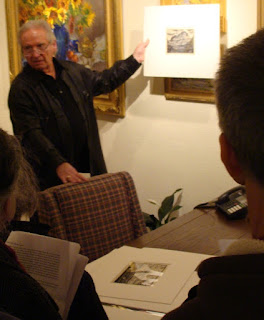
"It is always a pleasure to visit Mike Sim's workshop and gallery. There are few places where one can see so many prints as well as talk with the master printer who has worked with the artist to produce them." paul sokoloff
"I have signed up for Mike’s print making class mid-March to help me better understand the process. I am really beginning to love these things. I even took Picasso and More class at the Nelson where I got to make a monotype print and an intaglio print. By my doing it even makes me appreciate more that which I see." paula winchester
"A drive down to the West Bottoms brought us to the Dolphin Gallery, where prints by Laura Berman, Andzej Zielinski and Michael Krueger would be considered." paul sokoloff
Jack Olson of theAmerican Legacy (below) spoke on wood engravings by Paul Gentry.
"Inspite of the rushing, still there was time for some people to buy some prints at several of the galleries." susan lawrence
"Everyone enjoyed the opportunity to socialize with members and to visit so many galleries at one time." susan lawrence
"By 2:30 in the afternoon it was time for lunch and discussion. Our lunch was at Bella Napoli restaurant at 63rdand Brookside, where we enjoyed Italian food, good conversation, and cast our votes." susan lawrence "Our group selected 8 ink impressions for theluncheon in February. Double click on images to enlarge.
"Made In China" by Hugh Merrill from The Todd Weiner Gallery, 115 W. 18th St., Kansas City, MO 64108 (816-984-8538)
Sonatina by Jacqueline Bishop, 2010, lithograph in black over color archival pigment print, edition 22, image 18 ¼ x 60” on 22 x 64” sheet Sherry-Leedy Gallery, 2004 Baltimore, Kansas City, MO 64108 (816-221-2626)
"Eagle and Snake by Luis Jimenez, ’08, litho, 33-3/4”X 43”, Ed. 40 YES from Lawrence Lithography, 2011 Tracy, Kansas City, MO 64108, (816-471-4848)(image courtesy of Lawrence Litho, accessed Feb 2, 2013)
"Changing Of The Guards" by Michael Krueger, lithograph, 2012, ed. of 45, litho, 46” X 36”from the Dolphin Gallery, 1600 Liberty, Kansas City, MO 64102 (816-842-5877)(image courtesy of Davidson Galleries http://www.davidsongalleries.com/artists/krueger/krueger.php, accessed Feb 2, 2013)
"We will have a really good selection to see at our luncheon in February. Thanks to Beth Lurey for making her initial selections and to all the galleries that participated. It was a really fun and educational day. And I would say that a good time was had by all." susan lawrence
Contributors Susan Lawrence, Paula Winchester, Paul Sokoloff Photos by Robin Gross and John Mallery Layout and editting by Karl Marxhausen
IN ALL thirty-three 33 ink impressions were scrutinized. We viewed Luis Jimenez (1940-2006) Heron Skull, lithograph, 12/20, 21” X 21" -- Two Horses Skulls, lithograph, 11/20, 21” X 21” --- Mountain Spirits/Nuclear Rods lithograph, 1994, 47-5/8 X 33-1/2” -- Radioactive Skull, 20/20, lithograph ’1994, 32” X 31-7/8”-- Roberto Juarez(b. 1952, Chicago, IL) Portfolio of Seven Prints, no date, 3/20, 21-1/2” X 15-3/4" -- Joseph Raffael (b. 1933, Brooklyn, NY) Autumn Fish, ’98, 18/40, 31-1/2” X 24-1/4” -- Hugh Merrill,Kabwash, 2012, mixed media on paper, 12” x 16” -- Made In China, 2012, mixed media on paper 12” X 16” --Guanlan Days, mixed media on paper, 40”X 48 ¾” -- David Root,Icarus at Countdown, 2011, woodblock print, 24”X 24” -- The Log Roll, 2011, woodblock print , 21-1/2 X 8-1/2” --Norman Akers (b.1958, Fairfax, OK) The Gathering, 2012, color lithograph, edition 20, image 22 ¼ x 16 ¼” on 29 ½ x 21 ¼” sheet, printed and published by Mitchell Marty Studio (Santa Fe, NM) -- Jacqueline Bishop (b. 1955, Long Beach, CA) Sonatina, 2010, lithograph in black over color archival pigment print, edition 22, image 18 ¼ x 60” on 22 x 64” sheet, printed by Neal Ambrose-Smith and Karsten Creightney at Hand Graphics (Santa Fe, NM), published by Zanatta Editions (Shawnee, KS) -- Karsten Creightney (b. 1976, Albuquerque, NM) Untitled , 2009, suite of nine lithographs in black, edition 13, 10 x 10" each image/sheet, printed at Tamarind Institute (Albuquerque, NM), published by Zanatta Editions -- Emmi Whitehorse (b. 1957, Crownpoint, NM) Pollination, 2011, color monotype with collage elements (rice paper and sheets with monotype) and extensive hand drawn additions (pencil, color pencil, chalk and oil stick), unique from series, image/sheet 29 ¾ x 22 ¼”, printed by Michael Costello at Hand Graphics, Santa Fe, published by Zanatta Editions.Signed on front with artist’s mark in oil crayon; signed and dated on reverse in pencil -- Luis Jimenez,Eagle & Snake, ’08, litho, 32-1/4 X 43-1/4, Ed.44 --Eagle and Snake II, ’08, litho, 33-3/4”X 43”, Ed. 40 -- War Horse, ’01, litho, 22-1/4” X 42”, Ed. 50 -- Robert Sudlow(1920-2010) From Markleys Hill, 1995, chine colle -- John Newman (b. 1952, in Flushing, NY) Unraveling and an endless Loop --Three categories: Black, White, & Lying-- Laura Berman, Assistant Professor of Printmaking at the Kansas City Art Institute, Umbra Home, 2012, Suite of three, unique relief prints 20” X 15” -- Michael Krueger (b. 1967, Kenosha, Wisconsin) Changing of the Guards, 2012, ed. of 45, litho, 46” X 36” -- Drifter’s Escape, 2012, ed. of 45 litho, 46” X 36” -- Andrzej Zielinski, (b. 1976, Kansas City, MO) Orange Paper Shredder, 2009, 7/20, 7-color litho, 28-3/4” X 21-3/4”, printed at Lawrence Lithography, Kansas City, MO -- Robert Sudlow, Near Ottowa, lithograph, 27/60, 16” X 22-1/2” --Winter. Baldwin, lithograph, 7/54, 22-1/2” X 30” -- Maple Hill,’87, lithograph, 20/35 -- Paul Gentry (b. 1954, Independence, OR) Quiet Land, wood engraving, 15/25, 5-3/8 X 7-1/4” -- Big Sky, wood engraving, 7/30, 6-1/4” X 9-3/8” -- Shadows and Steel, wood engraving, 7/35, 9-1/4” X 7” -- Larry Welo, Cotton wood Falls, etching, 20 X 14 -- Duluth, etching, 38/100, 17-3/4” X 12”
During the Renaissance, print techniques on textiles were limited. One could use vats to dye fabric with amazing colors. The stamping of an image on cloth was another matter. Artisans could not figure out HOW to do it so that the image would not wash out. Their attempts bore poor results. What did work was painting the silk cloth by hand, as seen in the Parament from Narbonne (below). Textile artists would end up borrowing from printmakers.Using wood blocks and latercopperplate etching.DOUBLE CLICK ON IMAGES TO SEE ENLARGED.
The solution came to Europe in the 1500s, explained textile historian and artist Carla Tilghman. The Portugese discovered the ornate textiles of East India during their trips of exploration.
The patterns in the Indian fabric did not wash out and were vibrant.
The textiles from India provided an alternative to the heavy silks, the woolens, and the rough linens of the times. "Indiennes," as the French called the east indian prints, were popular among those who could afford it, namely French high society or royalty, both kings and queens. It had a "must have" appeal. The textiles were a colorful, lightweight, and easy to wash. More on indiennes HERE and HERE.
British East India Company
Soon every country had its own East India Company (maps above). This was their strategy. Gold bullion from Europe was used to buy spices from the Indonesian islands further east of India. They traded spices for the block print textiles from merchants in India. Both spices and textiles were imported to Europe.
Such that other countries came to India to set up their own colony of block print workers, for the sole purpose of producing textiles for their markets back home. Colonialism was a global market. There was competition and armies fighting for the textile production.
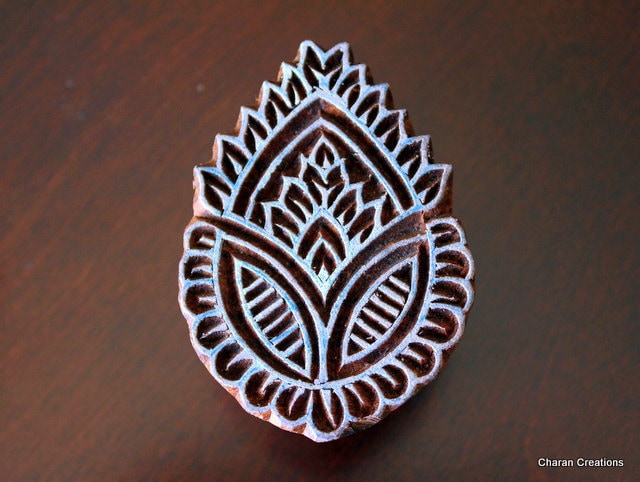
The dense wood of the endgrain was used for detailed designs. (above)
Today these same kinds of wood blocks are being cut in Sanganer, Rajasthan. The wood blocks are BIG. 15 by 15 inches in size. (See below)
The design was carved by hand on hard wood in Sanganer, Rajasthan (above).
The Blockmakers.mov . Watch 1 minute video. Intricate drilling of wood block. (Courtesy ofSteven Follen, accessed Nov. 14, 2012)
Fabric was laid on a table, a "squishy" table in Jodhpur, India. The wood block was inked and carefully lined up on the fabric and pressed down by hand. Then inked again, positioned, and pressed down. Eventually creating a sequence of shapes across the fabric. Lighter colors were laid down first. Darker colors were laid down later.
Light dye was put on dark color fabric.
A combination of large and small blocks were used to create patterns.
India Block Printing. Watch three minute video showing the carving process for wood blocks. (Courtesy of westelmvideo, accessed Nov. 14, 2012)
India--Iqbal,bvlock printer extraordinare. (Click on X in upper right of ads and they will disappear) Watch six minute video of inking block, positioning it on the fabric, and thunking the block. (Courtesy of mammoth9119, accessed November 14, 2012)
Chemical formulas were figured out by artisans in Barmer, Rasasthan. Regions were known for their particular block printing method. Red and blue were the essential Indian colors used.
Color dyes come from two plants: Chay (k-igh) and Indigo (in-dee-go)
CHAY
Orange tinged red ~ Turkey red
INDIGO
Blue
The tighter molecular structure of the plant makes the color stronger, more intense.
The dye was fixed by using natural calcium in water,
which was available naturally.
Block printed fabrics were washed in Barmer River and laid out to dry.
The imported East Indian calico prints were so popular in Europe that wool and silk manufacturers became upset and raised a fuss. Bans and fines were imposed to protect the silk, wool, linen and hemp industries. In 1686 the French King Louis XIV imposed a ban. In 1700 England passed an Act of Parliment to prevent the importation of dyed or printed calicoes from India, China or Persia. English manufacturers got around the rule by importing the raw unprinted, undyed cloth (which is what calico is). The grey cloth was then dyed and printed with the popular patterns in southern England. More on the bans HERE. More on calicos HERE and HERE. When the French ban was lifted in 1759, Christophe-Philippe Oberkampf (1738-1815) and Antoine Guerne established a printworks in Jouy-en-Josas, 15 miles outside Paris. His firm used the techniques of wood block printing, copper plate printing, and roller printing.
French, Indienne, wood block printing, Factory in Mulhouse, Alsace, 1760 c
Indienne, Wood block printing on cotton,
factory Oberkampf in Jouy, 1785 c (Courtesy of Musee Impression,http://www.museeimpression.com/gb/collection/jouyZoom.html, accessed Nov 21, 2012. Europeans liked light backgrounds for their exports.
Robert Jones & Co. (printer), Length of furnishing fabric
Old Ford (London), England 1769
Linen and cotton, printed from engraved copper plates
Europeans liked light backgrounds for their exports.
Chintz, Palampore, Amsterdam coat of arms, c 1710,
painted and dyed cotton, det 1 Coromandle made,
The Victoria and Albert Museum, London
This was an export from Amsterdam.
19th c block print sample cloth
This was intended as export for the Siam market.
Calico temple veil, Persian factory, wood block print on cotton, c 1850
European workers painted and dyed cotton.
Europe had its own bleaching fields.
When asked what was used to bleach linens, Ms. Tilghman discussed the use of buttermilk. Acids in the buttermilk were thought to bleach the linens. The Buffalo milk that was used in India was used fixed the dyes in the fabric. Click two minute answer (above) to question raised by a member of the Kansas City Print Society at the Nelson-Atkins Gallery Saturday morning, October 13th.
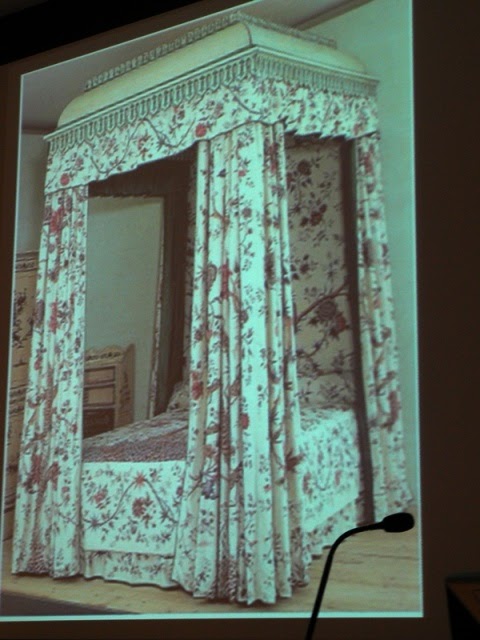
Underwear petticoat made for clothing in Europe.
Doll clothes bore calico floral patterns.
Watch 40 second video. "An exhibition was put on in London just this last year about those textiles and those records. We can track the development of the the use of calico in cotton fabrics, at least in London, and we can do it across class lines. So, the book has become a little treasure trove of information rediscovered within the last ten years. They are two very lucky scholars. So we have lots of information from their writing. One British scholar named Beverly LeMire and a British man named John Stiles, and they have written a lot about the calico industry." Ms. LeMire edited "The British Cotton Trade, 1660-1815."
Watch 56 second video. "And it was developed through the use of rollers. Initially, copper plates. What a surprise, copper plate printing. But eventually they get turned into rollers. And roller plate printing becomes the way to print fabric. Look (first photo) this is marketed as an indienne fabric with a Chinese scene. (audience laughter). (second photo) So this isa combination of a printed cotton fabric from France, that uses both the copper roller and the wood block. You are seeing early on using combinations. Eventually you do see the copper plate and rollers replace the woodblock."
range of customers. It was less expensive than silk
.
Watch 2.25 minutes about etching technology. "And here is the fabric that is coming off the rollers. So, you can stop these rollers so that each of them can be inked with a different color. And you are literally running your fabric past the rollers. So the rollers are actually pressing down of the fabric as the fabric is moved past it. The rollers become stationary and it is the fabric that moved. It is a more efficient way to create long lengths of fabric. And I am not going in to this other than to say that -- This technology was also very tied with the development of power looms. The power loom was what allowed an incredibly long length of fabric to be woven very quickly and very efficiently. So these technologies are all linked. (audience laughter) (next slide of roller diagram) There is a lint doctor. It amuses me that this really is taking a look at etching technology. You have the blanket. You have the back fabric. You got something to press against. You got a way to run it through a lot of pressure. There are a lot of similarities. Francis (Key) Nixon is the one in 1773, the Irish guy, who invented the first copper roller. I think he would be a smart guy looking at how etchings were made in terms of pressure. So, you have each individual roller that can be dunked into, or, actually this is a separate wheel that inks the roller right here, and the roller rolls right on to the fabric, and of course it is backed by these two other squishy tables, and all of this is up against a pressure bowl. So, you have to adjust the pressure of all this, so that the pressure is even, and then the fabric comes out, and it would move out onto an enormous long dyer belt. And then, eventually the fabric goes on to another roller at the end, but of course all of it would have to have a chance to dry without being smooshed." More on Printed Textiles 1760-1860 HERE.
Double sided printing fabric machine
Watch 2.30 minutes. "The printer belt here and then the drying rack and then it is rolled off into bolts. And of course these bolts have to be washed. So you take the bolts off the roller and you take them to another place that unrolls them and runs them through a washing bath. You have to wash any of the extra dye off. Because these materials can be made in huge long bolts of cloth, they become pretty inexpensive. This is a pretty cost effective way, because you don't have to pay as much labor. Labor costs does not become your primary expense, Machinery becomes your primary expense. (next slide) This is a fully mechanized printing factory from the late 1800s."
(question: How do they get the excess dye off? What keeps the dye from coming off and getting all mooshed together?) "This is where those things I call mordants come in. What the mordants do is chemically bond at the molecular level with the dye and the plant fiber. Whatever is excess literally gets washed out and not bound to the fiber. And that is why you dry it first. You let the chemical interaction happen only in those little areas. (next slide) (1860 eng Calico power loom, Circle of Science) An advertisement for printing. This is actually a print that I own. So the way they try to market these things. (next slide) This is a calico printing factory, so these are just two guys that happen to work there (standing beside rolled calico cloth). I steal from Getty Images, which is gettyimages.com. You can see how much the fabric looks like those Indian imports. It is clear that these printed fabrics suddenly take on a life of its own in Europe. These printed fabrics still with the Indian motifs, these last for a long time in terms of use and in terms of popularity."
The tradition of block printing in India continues today in Bangorlore, India.
See one instance at Devakis here and here. That site again is http://devakis.in/ Check out their gallery of block print designs http://devakis.in/custom.php This mother and daughter home business began in 1996. (update courtesy of Devakis, http://devakis.in/, accessed Feb 13, 2013, from moderated comment below)
M.A., Art History, MFA Studio Arts, textile artist, associate professor
Carla is researching and writing the first text book on the history of textiles published since 1979. Being a textile artist herself, she merges the artist with the historian's view of textiles.