Thursday, November 10, 2016

litho print - members


One huge block has been prepared. Margins sealed. Members of the Nelson Atkins print Society divide into two groups and work as a team to draw, drip, scribble, and distribute grease on the open space.


Four minutes.


"was struck by both the sensuality and physicality of the lithography-making process. The way I view and appreciate lithographs will be changed thanks to the afternoon spent with Mike Sims at Lawrence Lithography."  Stephanie Knappe

Drawn stone waits to be moved over to the press bed.

"I will say it was fun to participate as it has been a very long time since I have participated."  Beth Lurey


Five minutes. The 21 x 30 inch Bavarian limestone BLOCK is heavy.

During our visit to Lawrence Lithography Workshop, I was most surprised at the amount of time required to go from a blank stone to a completed edition. Making a lithograph is not just about art, it is also about understanding the chemistry behind the process. Now I understand why lithographers such as Bolton Brown and George Miller were held in such high regard. To become a master lithographer requires dedication, skill and perseverance.  My personal take-away after "marking up a stone" was that when I look at a lithograph (black and white anyway), I have a better understanding of how the marks were made. Not so sure with color. I saw a Miro color lithograph recently and I was completely stumped.  John Mallery


Four minutes. Talc powder on block keeps on grease from smearing. It also acts as an acid resist.


Tricky calculations take experience. Guesswork. Deciding how to etch the block. Mixing it each time. A WEAK mixture lightly etches delicately drawn areas. A STRONG mixture etches everything else. Mike Simms, who manages the Lawrence Lithography Workshop in east Kansas City, is a Master Lithographer.


The etch is a chemical change that locks the grease into portion of the stone. After the etch is done, Simms uses solvents to remove the surface grease. Water is sponged over the whole block. Then ink is rolled on. Then a water wipe and another ink pass. Ink sticks to portions where the grease is locked into the stone. It is time consuming. The number of water wipes and ink rolls are measured. Then a paper sheet goes over it and goes through the press. One image is pulled off. 

Then the process of water wipes and ink roll-ons are done exactly the same as before. Building up the layer ink and water. Then paper through the press and a second image is pulled off. As so on.


Simms proofed the block with six individual sheets of newsprint. Until he was satisfied with the image's appearance. Each member who participated went home with an approved inked lithograph.

Details from both group lithographs follow:


 Group A


Group B


All on one sheet of BFK printmaking paper

Videos and photos by Karl Marxhausen, print society member


Friday, September 30, 2016

sandzen studio - lindsborg

December 28, 1930
Charter member of the Prairie Print Makers
met in front of the studio of Birger Sandzen

 Charter members of Prairie Print Makers


Birger Sandzén’s studio is still in the same condition it was in on the day that he died. Members of the Nelson Atkins Print Society drove out to Lindsborg, Kansas to take the tour of Sandzen's studio. Our entourage was divided into two groups. In this manner both groups were able to see the inside of the studio and listen to the gallery staffer speak.
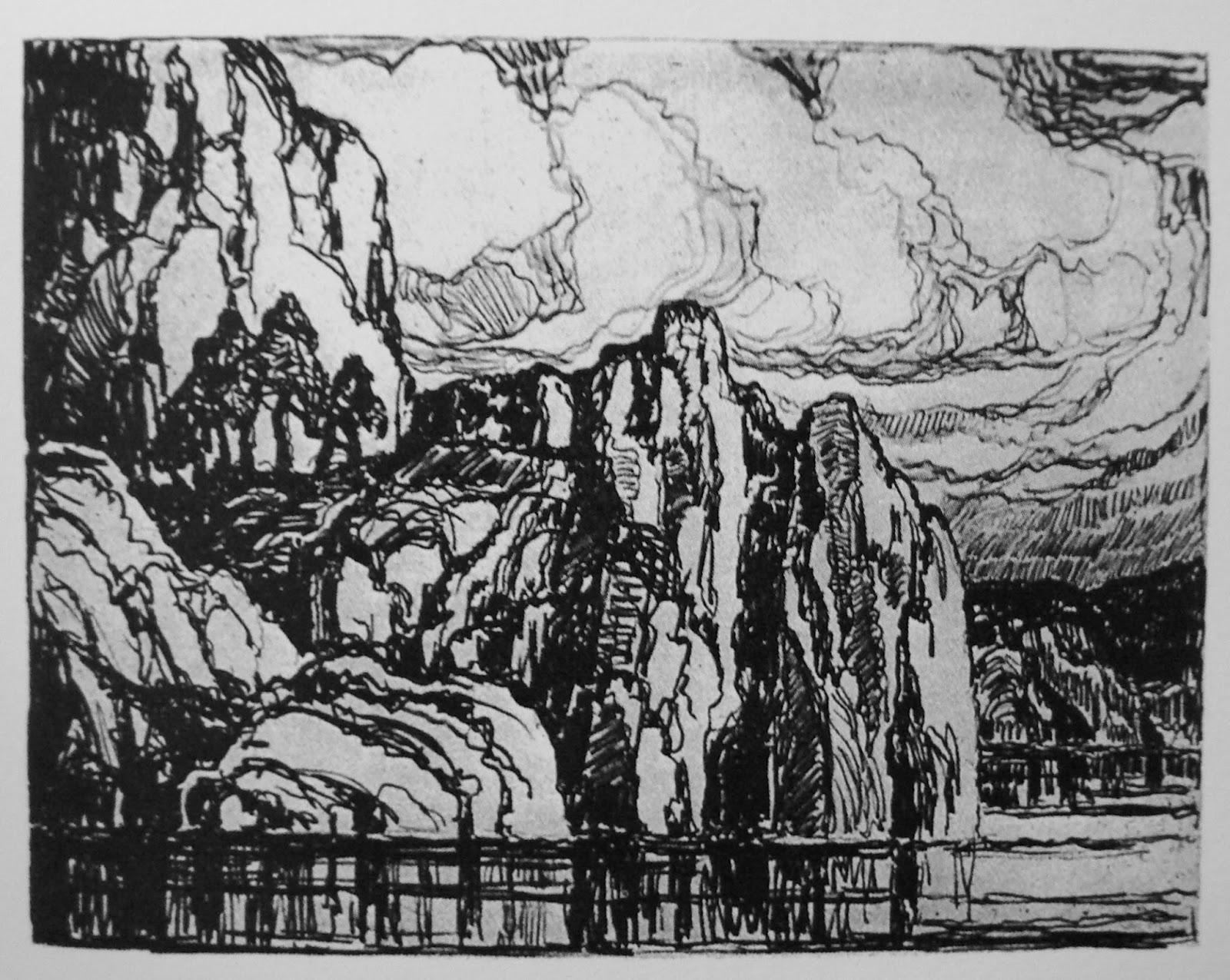
"Granite Banks," Lithograph, 1932, Birger Sandzen


Eighteen minutes. Our guide Rose Marie Wallen led us. Our group saw the big brushes the painter used, his library of books, the handmade apple trees, the oriental statuary he admired and much more. Double click on image to enlarge.
"Trees and Hills," Lithograph, 1920, Birger Sandzen

"Smoky Hill River," Linoleum cut, 1938, Birger Sandzen

Sandzen's desk

Studio has not yet been added the the National Registry of Historic Places.


As we walked back to the main gallery, I couldn't help but notice the trees on campus. The kind that show up in Sandzen's imagery. Take the Ponderoso pine below.


"In the Heart of the Rockies," Woodcut (Nailcut), 1919, Birger Sandzen


Today the premises where the studio of Birger Sandzen stands looks like any other property in Lindsborg. Yet it was here that relationships with Sandzen - discussed, made plans, shared the latest endeavor, and encouraged each to cut wood blocks, draw litho stones, paint canvases. Art students carried their experiences beyond Lindsborg. The memory of this place remains a touchpoint.           Karl Marxhausen

-----------

Photo of Prairie Print Maker Charter Members courtesy of "The Prairie Print Makers," Exhibits USA and Mid-America Arts Alliance, 2001

Post by Karl Marxhausen
++++++++


Thursday, September 29, 2016

john mallery - maurice bebb

After the curator's talk on Birger Sandzen, members of the Nelson Atkins Print Society gathered to look at the etchings and dry points of the Oklahoma artist, Maurice R. Bebb 1891-1986. Print Society president John Mallery spoke on Bebb's works. 


According to Mallery, Bebb had a unique printmaking career. He didn’t start drawing until he was in his 50’s and started printmaking full time after he retired as a florist in 1951 (Bebb’s Flowers is still in business in Muskogee, OK, although it is no longer owned by the Bebb family). 
Maurice Bebb was best known for his color multiplate, soft-ground etching and aquatint prints of birds. But he also created wonderful landscapes and architectural prints, many as a result of his two trips to Europe in 1956 and 1958. He created gift prints for the Chicago Society of Etchers, Printmakers Society of California and the Prairie Print Makers.


Mallery gave his presentation on Maurice Bebb and provided unique insight into the artist since he contributed to the catalog's raisonné.


Twenty-eight minute talk on Maurice Bebb's etchings. Birger Sandzen Memorial Gallery on campus of Bethany College, Lindsborg, Kansas

Mallery loaned 80 works from his collection to create the retrospective exhibition.


A collaboration between John Mallery, curator Cori Sherman North and Jim Harbison produced the book "Birds and Beyond: The Prints of Maurice R. Bebb." Now available through Amazon.


++++++

Post: Karl Marxhausen